You know the math. Every new retainer client your agency signs adds another brand voice to maintain, another approval loop to manage, another set of briefs competing for your team's attention. At some point, you hit a wall: hire more people and watch margins shrink, or stretch your current team and watch quality follow.
Most agencies respond by stacking tools. A drafting tool here, a project tracker there, a shared folder of brand guidelines that nobody updates after the first week. And now, with general-purpose AI widely available, the instinct is to hand everyone a login and tell them to draft faster.
That works for a while. Then it stops working.
The Editing Bottleneck

Agency practitioners consistently report that AI handles roughly the first 60 to 70 percent of a content draft: the research, the outline, the initial prose. The remaining 30 to 40 percent (where the draft starts to sound like the client and hit the right strategic notes) still belongs to your team.
One independent test found that AI cut initial drafting time from about three hours to twenty minutes, but editing still took around forty-five minutes per piece. Generation got faster. The queue of drafts waiting for human review got longer.
This is the limit of a writing tool. It produces text. It does not manage who reviews that text, which client's voice it should match, whether it meets the brief, or how it moves from draft to approved. When your team is already stretched, faster generation without structured governance means a bigger backlog, not a smaller one.
What Separates a Content Platform from a Writing Tool
The distinction is operational, not cosmetic.
Industry analysis identifies six dimensions where content platforms differ from standalone writing tools: collaboration features, brand consistency enforcement, native integrations, governance and audit capability, structured support and SLAs, and commercial pricing built for teams. These determine whether AI helps your agency scale delivery or gives your team more loose drafts to wrangle.
For an agency running multiple client accounts, those dimensions translate into specific needs.
Per-client brand-voice governance. When you manage ten clients, each with a distinct tone, a specific vocabulary, and things they will never say, the AI layer needs to enforce those boundaries by default. One documented agency implementation described a setup where it became structurally impossible to accidentally apply the wrong client's voice, with an audit trail showing which team member generated content for which account. That is governance, not generation.
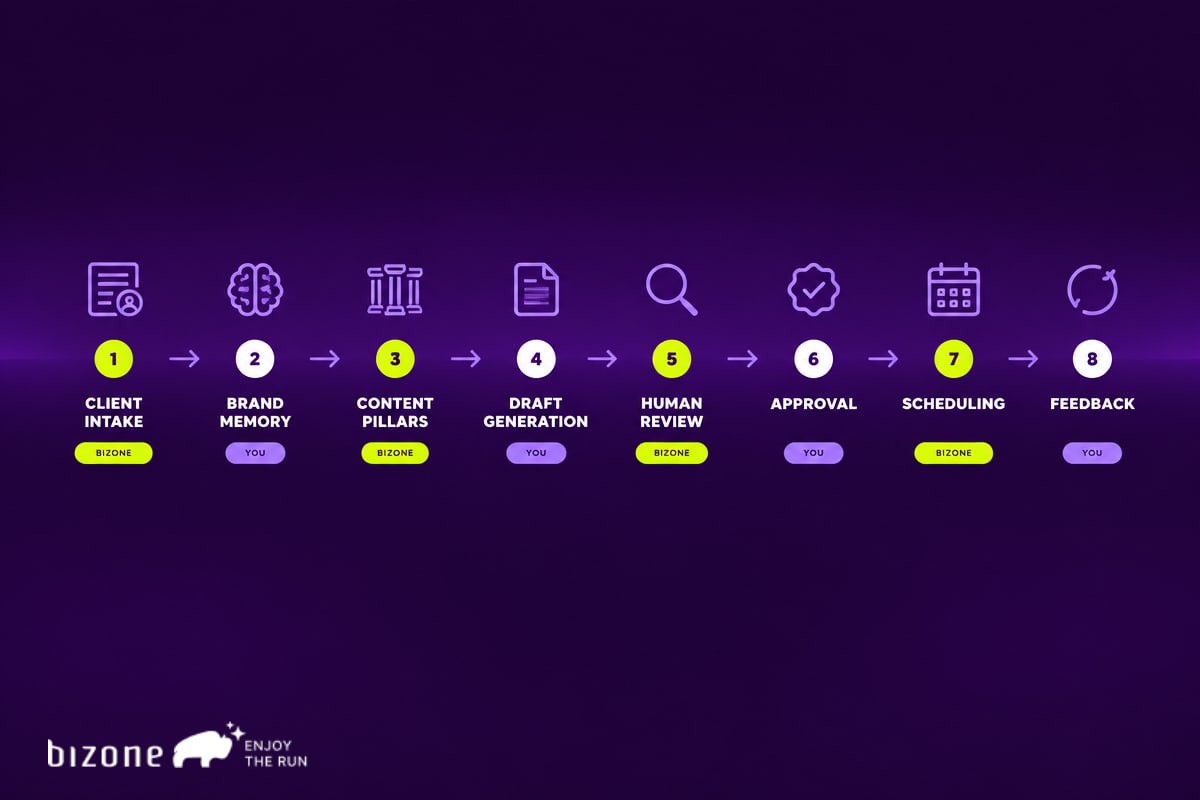
Structured workflow and approval chains. A practical agency content workflow follows a clear sequence: client intake, brand memory, content pillars, draft generation, human review, approval, scheduling, and feedback. When agencies skip designing this process and jump straight to AI drafting, the result is more output that somebody still has to review, correct, and route. The workflow is the product, not the text generator sitting inside it.
Client separation and audit trails. Agencies handle confidential client strategy: upcoming launches, competitive positioning, internal messaging. Each client's data must stay isolated. Audit logs need to show who did what, when, for which client. For any agency handling enterprise accounts, this is the minimum.
Compliance infrastructure. A SOC 2 Type II audit tests security controls over six to twelve months of continuous operation, covering security, availability, confidentiality, processing integrity, and privacy. ISO/IEC 27001 is the global benchmark for information security management, requiring staged audits and ongoing surveillance. For agencies working with international clients or regulated industries, the platform your team runs on needs to meet the same compliance standards your clients expect of their own vendors.
There is also an emerging regulatory dimension. Since August 2026, provisions under Article 50 of the EU AI Act have applied to AI-generated content, raising questions about who used the AI system, what the AI did to the content, and whether the audience could reasonably mistake the output for something created without AI. Those governance questions land on the agency, not just the tool vendor.
Why This Matters Now
The competitive pressure is specific.
Businesses are finding that smaller internal teams paired with AI tools and specialist content partners can produce work faster and at lower cost than a traditional agency engagement. That puts agency pricing, turnaround, and demonstrated value under direct scrutiny. According to figures attributed to the Content Marketing Institute, roughly 81 percent of B2B marketers report using generative AI, but only about 19 percent have built it into their daily operations. The distance between having AI access and actually running on AI is where agency value either compounds or leaks.
There is a related quality problem. When multiple agencies and in-house teams use the same general-purpose models trained on the same data, the output converges. Practitioners cite survey data suggesting roughly half of readers can recognize AI-generated content and tend to disengage from it. For an agency selling thought leadership and executive voice, that sameness is a structural problem. Brand-voice governance at the platform level, enforced per client, is what keeps your work distinct.
Where Bizone Fits
We built Bizone as a content operating system for B2B content agencies.
The word "operating system" is deliberate. We handle the legwork: research, ideation, first drafts. Your team does what only they can do: set the strategic angle, manage the client relationship, apply editorial judgment, and have the last word before anything publishes. Your team is the expert in the room. We are the infrastructure behind that expertise.
Bizone is purpose-built for the workflow your agency already runs. Per-client workspaces keep each account's brand voice, strategy, and content separate. Structured review and approval flows match how your team actually moves work from draft to delivery. And the compliance architecture (SOC 2 Type II attested, and certified to ISO/IEC 27001:2022) is designed for agencies that handle sensitive client work across borders.
Our engineering team built mission-critical financial systems before building Bizone. That background shapes how we approach data separation, audit trails, and the kind of reliability agencies need when client trust is on the line.
We are not a general-purpose writing assistant adapted for agencies. We are the system your agency runs on.
How to Evaluate a Content Platform
If you are comparing platforms, a practical evaluation framework covers seven dimensions: brand context understanding, client environment separation, review and approval control, publishing integrations, failure handling, measurement capability, and commercial fit.
Score each dimension against a real brief from a real client. A pilot tells you what a demo cannot.